Improving Quran reading is a spiritually enriching journey connecting Muslims to Allah’s words, yet learners often face hard challenges.
For Muslims, the challenge is not only Quran reading online but to read the Quran fluently, beautifully, and with an understanding meanings.
Whether you are a beginner or someone who wants to strengthen your fluency, there are simple and practical ways to improve your Quran reading.
This comprehensive guide provides effective, simple tips for your Quran Reading and motivation to help you excel in your online Quran reading journey.
We will explore practical and easy tips to enhance your Quran reading, from understanding Tajweed to building daily habits.

Start your Quran reading journey today with Blqlm Academy, the world’s leading platform providing expert teachers, flexible programs, and complete online learning tools.
Simple Tips to Improve Your Quran Reading
The Quran (القرآن الكريم) is the ultimate source of guidance for Muslims worldwide.
Every word, every ayah, and every surah carries divine wisdom that helps believers connect with Allah (SWT), the Beneficent and Merciful.
Reading the Quran correctly is not only an act of worship but also a way to understand its deep meanings.
To improve your Quran reading, master Tajweed rules for correct pronunciation, understand the meanings of the verses, and practice daily with a focus on improving pronunciation, intonation, and breath control.
Listening to skilled reciters and mimicking their techniques, recording your own recitation for self-assessment, and seeking guidance from experienced instructors are also highly beneficial steps.
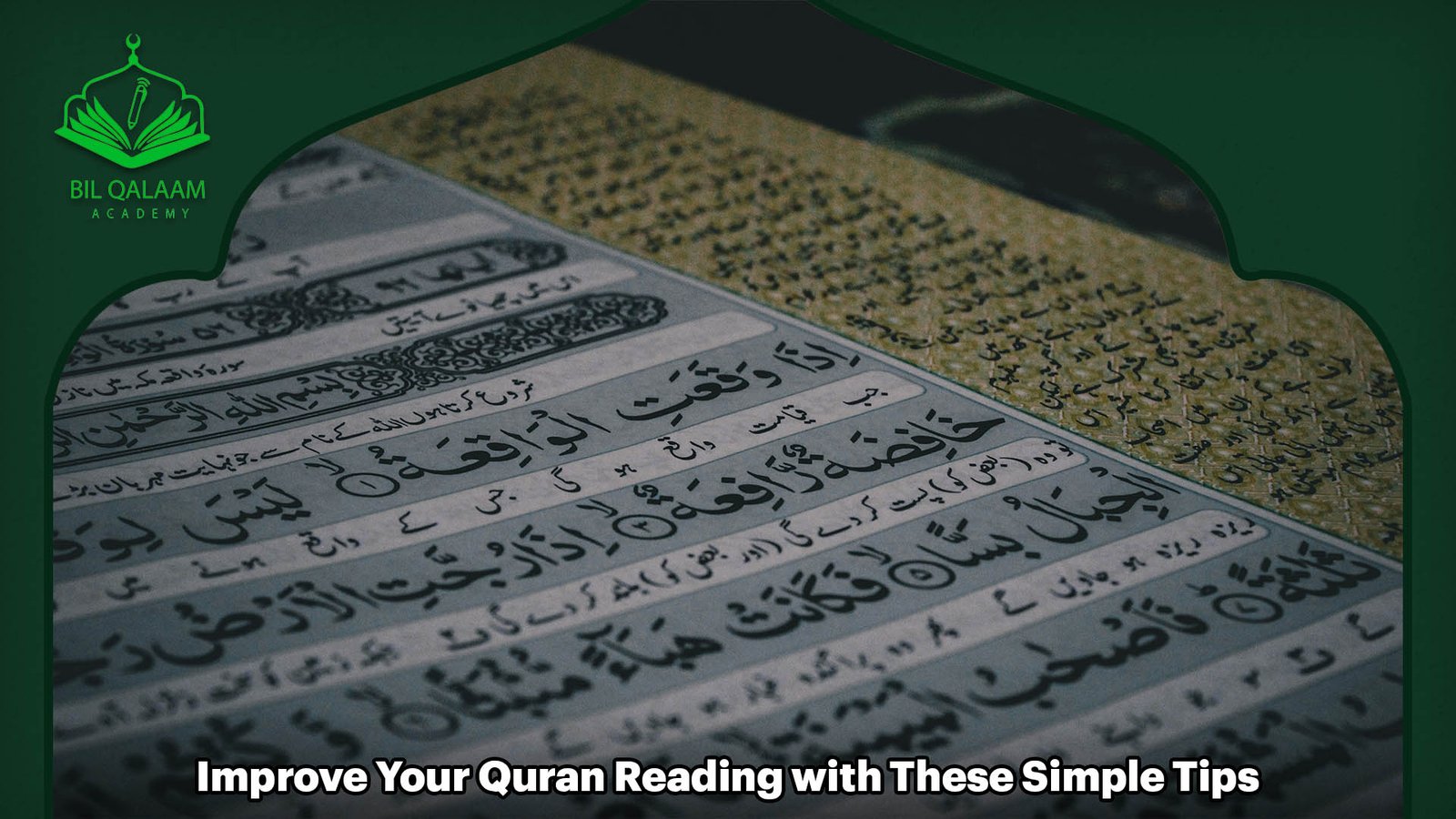
Why Improving Quran Reading is Important
Reading the Quran beautifully and correctly is not only about fluency but also about faith and spirituality.
Correct recitation:
- Preserves the meaning of Allah’s words.
- Helps avoid errors in pronunciation.
- Brings peace, blessings, and closeness to Allah.
- Enhances understanding when paired with translations (English, Urdu, Arabic, and other languages).
- Motivates students to continue learning and exploring deeper levels of the holy Qur’an.
The Prophet Muhammad (PBUH) encouraged Muslims to recite the Quran with Tajweed and strive to improve, even if reading feels difficult at first.
Start with the Basics of Tajweed
Tajweed (تجويد) means “to improve” or “to make better.”: Tajweed is the science that teaches us how to pronounce each letter of the Quran properly.
Learn the Makharij (Points of Articulation): Every letter in Arabic has a unique makhraj (point of articulation). Learning where sounds originate, such as from the throat, lips, or tongue, will improve clarity and prevent mistakes.
Apply Tajweed Rules Gradually: Instead of overwhelming yourself with all the rules at once, learn one Tajweed rule at a time.
For example:
- Start with elongations (Madd).
- Move to nasal sounds (Ghunna).
- Then practice the rules of Noon Saakin and Tanween.
This step-by-step approach will make recitation easy and sustainable.
Develop a Daily Quran Reading Habit
Consistency is the key to fluency.
- Set a Fixed Time Daily: Dedicate a fixed time daily, such as after Fajr or before bed, for reading the Quran.
- Start Small and Increase Gradually: Begin with a few lines or one ayat (verse) and slowly build up to a full page (para/جزء).
- Keep a Mushaf Handy: Always keep a mushaf (مع المصحف) or a mobile Quran app with you. Even reading a few verses during free moments adds up.
Listen and Repeat After Expert Reciters
Listening to beautiful recitations helps you imitate correct pronunciation.
Choose a Reciter You Admire: Select from world-famous reciters like Mishary Alafasy, Abdul Basit, or Al-Husary.
Use the “Listen and Repeat” Technique: Play an audio recording of the reciter, then pause and repeat after him.
Use Technology to Your Advantage: Download Quran apps with features like word-by-word audio, multiple recitations, and translations in different languages.
This makes listening and learning easier, even for students on the go.
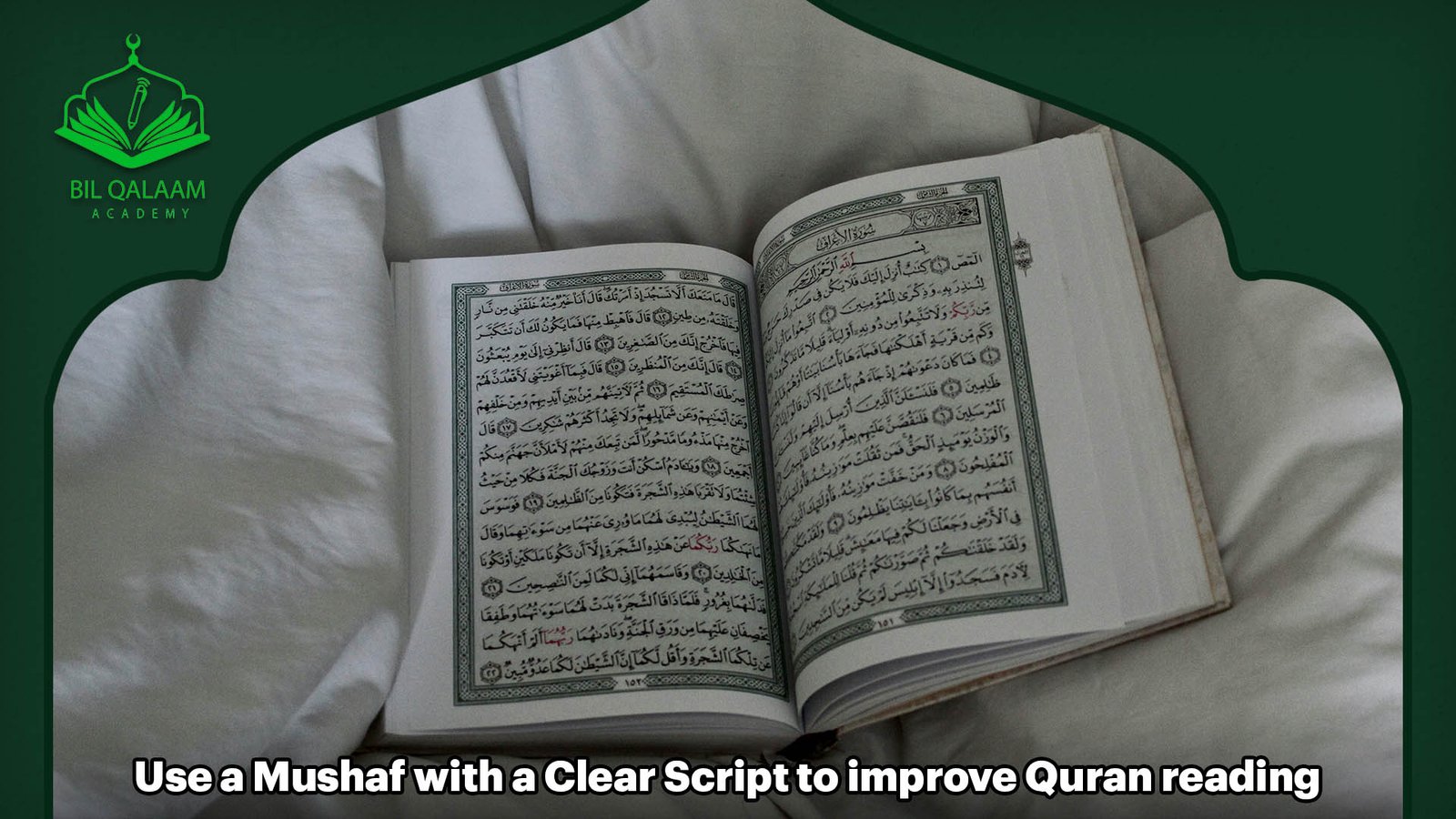
Use a Mushaf with a Clear Script to improve Quran reading
A good mushaf makes reading smoother and less stressful.
Select a Mushaf with a clear, comfortable-to-read script, larger text if needed, and clear Tajweed marks to help with correct pronunciation and intonation.
Large Font Mushaf: Large fonts help beginners and elderly Muslims read with comfort.
Color-Coded Tajweed Mushaf: Color-coded letters highlight tajweed rules so students can learn while reading.
Consistency in Mushaf: Stick to one style of mushaf instead of switching, so your eyes and memory adapt.
Break Words into Smaller Parts
Breaking down verses into smaller parts aids in understanding and Quran memorization.
Also, breaking words down makes complex ayat easier to read.
- Word-by-Word Reading: Focus on each word individually before joining them together.
- Focus on Difficult Words: Underline or mark challenging words and repeat them daily until they feel easy.
- Use Transliteration Wisely: Transliteration can help beginners, but relying too much on it may harm Arabic pronunciation.
- Always return to the original Arabic script: This approach helps to be coupled with patience and consistency, enhancing the overall Quran reading and comprehension experience.
Learn Commonly Repeated Words
To improve Quran reading by learning commonly repeated words, focus on repetition, and repeatedly read and memorize verses and sections.
Start by focusing on individual words, repeating them until comfortable, and practice reading a page immediately after prayer.
The Quran has many recurring words like Allah, Rahman (Beneficent), Rahim (Merciful), and Iman (faith).
- Recognize Key Vocabulary: Memorize commonly repeated words to speed up reading.
- Build a Quranic Word Bank: Keep a notebook or use an app to list and review new vocabulary.
- Connect Vocabulary to Meaning: Learning meanings alongside reading improves comprehension, especially when using translations in English, Urdu, or your preferred language.
Consistent practice is key to memorization and improving reading fluency.
Seek Guidance from a Qualified Teacher
To improve your Quran reading, seek guidance from a qualified teacher.
Enrolling in Quran classes online offers structured instruction and personalized feedback to focus on Tajweed, intonation, and pronunciation.
Must consider different recitation styles and overcome any fear or uncertainty by seeking guidance.
A qualified teacher provides tailored advice and helps you develop a deeper understanding of Quran recitation.
Self-study helps, but a teacher is essential for mastering Tajweed.
An experienced teacher corrects mistakes that students may not notice themselves.
Join platforms like Blqlm Academy, the world’s leading provider of Quran teaching, offering male and female Quran tutors, flexible schedules, and live sessions.
Participating in masjid circles strengthens both reading and Islamic brotherhood/sisterhood.
Practice Quran Reading Out Loud
Silent reading may feel easy, but recitation out loud improves fluency.
To improve your Quran reading out loud, practice consistently by reciting daily, focusing on correct Arabic letter pronunciation (Makhraj), and applying the rules of Tajweed for rhythm and flow.
Listen to skilled reciters to imitate their intonation and technique, record your own reading to self-assess, and use proper breath control for a smooth delivery.
Seek guidance from an experienced teacher (Ustadh or Ustadha) to correct mistakes and gain personalized instruction.
- Avoid Silent Reading: The Quran should be recited with voice, not just read silently.
- Record Your Recitation: Use a mobile app to record yourself and compare it to expert reciters.
- Read in Front of Someone: Quran Reading in front of your teacher or family ensures accountability and feedback.
Track Your Progress Consistently to improve your Quran reading
To consistently track and improve your Quran reading, establish a regular, achievable reading schedule and set specific daily goals for verses or pages.
Regularly review your progress, identify areas of struggle through analytics, and consider joining a study group for accountability and to receive feedback from others.
- Use a Bookmark: Mark where you left off in your mushaf to stay consistent.
- Quran Apps with Progress Tracking: Apps let you set daily goals, track recitations, and explore learning milestones.
- Reward Yourself: Celebrate small achievements to stay motivated, such as finishing a para or reciting a surah without mistakes.
Make Dua for Ease and Barakah to improve your Quran reading.
To make Dua for ease and Barakah in Quran reading, start by seeking forgiveness and mercy from Allah for yourself, your parents, teachers, and the entire Muslim community (Ummah).
You can also recite specific duas, such as the one asking Allah to bring you out of the darkness of doubt and bless you with understanding the Quran.
- Start with Intention: Make a sincere niyyah (intention) to read for the sake of Allah.
- Dua for Ease: Pray: “O Allah, make the Quran the spring of my heart, the light of my chest, and the remover of my sadness.”
- Stay Patient and Consistent: Improvement comes with time. Keep making dua for barakah (blessings) in your learning.
Common Mistakes to Avoid
Common mistakes to avoid when improving Quran reading include mispronunciation of Arabic letters, incorrect elongation, and improper stopping.
Other errors involve rushing through the recitation and a lack of understanding of the words.
To improve Quran reading, focus on accurate pronunciation, proper elongation techniques, and correct pausing.
Understanding the context of the verses aids in avoiding these common pitfalls.
Common Mistakes to Avoid
- Reading too fast without tajweed.
- Depending only on translation without reciting Arabic.
- Ignoring repetition and revision.
- Switching mushafs frequently.
- Avoiding teachers due to shyness.
Additional Practical Tips to improve your Quran reading
- Use a quiet place for better focus.
- Pair your recitation with the Quran tafsir to understand meanings.
- Encourage children by making Quran learning fun.
- Use both mobile apps and printed mushaf for variety.
- Explore Quran programs in multiple languages to deepen knowledge.
In Conclusion, start your Quran reading journey today with Blqlm Academy
Improving your Quran reading is a lifelong journey.
By combining daily practice, tajweed, listening to expert recitations, and guidance from qualified teachers, you can achieve fluency and a deeper connection with the holy Qur’an.
Platforms like Blqlm Academy make it easy for Muslims around the world to learn through online programs, live tutors, and mobile apps.
Whether you are a beginner or advanced student, remember: consistency, patience, and sincere intention are the keys to success.
May Allah make the Quran the light of our hearts and grant us the ability to recite, understand, and live by its teachings.
Start your Quran journey today with Blqlm Academy, the world’s leading platform providing expert teachers, flexible programs, and complete online learning tools.